
The crackdown on the ‘dog mafia’ in Luxembourg

Have you ever wondered why the dogs belonging to street beggars lie motionless for hours, wrapped in blankets even in warm weather? An activist and former animal welfare inspector, together with like-minded individuals, launched Petition No. 3921, which has caused a stir in Luxembourg. This is an honest discussion about how to distinguish genuine need from a cruel ‘business’ preying on animals, why the police cannot always help, and what loopholes in the law allow four-legged friends to be exploited for the sake of alms.
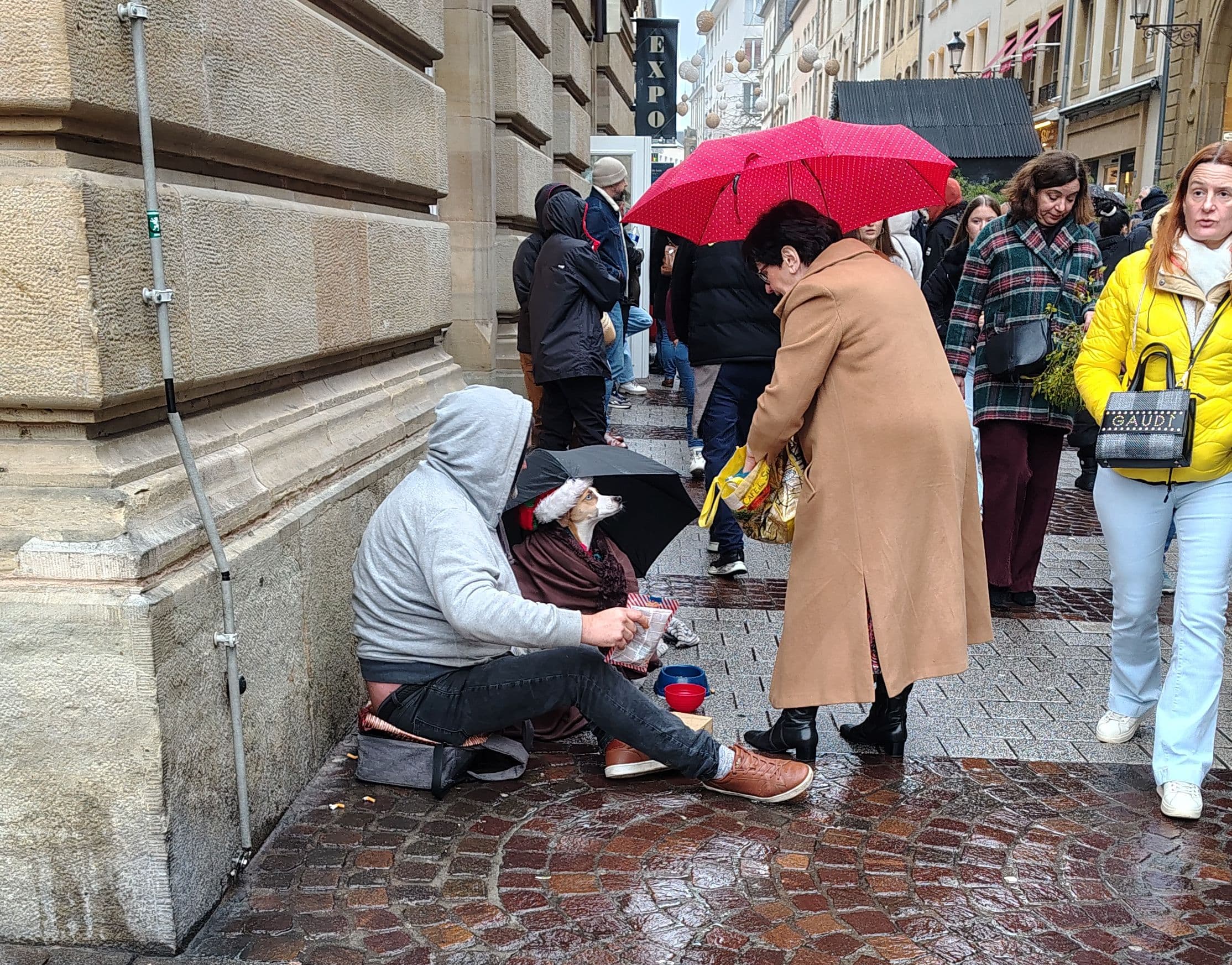
Photo by Tess Martin
What motivated you and your colleagues to launch petition No. 3921 about animals used in begging?
I had always been active in animal welfare. I was an animal welfare Inspector for the National Animal Welfare Liga on a volunteer basis while still working fulltime. I did this for over 10 years (until 2006) and was practically the only one treating cases all over Luxembourg (driving to location, checks etc). When becoming a mother, I had to step down (as this ‘job’ requires a lot of time, stamina and follow-ups).
I started as a freelance Tour guide in the city last year and noticed a lot of beggars (which I could identify as ‘organised’). I documented, talked to some of them (or tried to), reported to Veterinary Inspection and talked to Police. I started posting on social media to raise awareness. Then I looked for ‘content creators’ with a higher number of followers and asked one of them, Tiago Rodrigues, to publish an article about this subject on his page. Which he did. The idea of a Petition was an idea from the get-go.
And from there, we decided to take action together as Tiago was willing to invest in this cause with me. We became a Team. I created a page solely for this purpose with subject information and updates and Tiago published equally on his page. We both concentrated our efforts solely on this for the time of pre-and during time of the Petition. Day after Day we wrote about the subject in order to motivate people to sign.
You mentioned that the situation has worsened in recent years. What changes have you personally observed?
20 years ago, we mostly had local beggars. Over the recent years a definite change in the landscape of begging became very noticeable. Same individuals, same modus operandi, same set-ups, coming into the city in groups (either being dropped off, and/or by train and busses and then disperse all over the city, dogs interchanging between them for begging rounds) It happened increasingly and very consistently.
In which areas of Luxembourg is this phenomenon most visible?
In the city centre they are visible on ‘known’ spots for beggars. Shopping streets, Hamelius, Cercle Municipal, Gare area. Some tend to occupy the exact same spot each day. Outside of the city they are often located in front of Supermarkets. You can see them all over Luxembourg.
What are the typical signs that suggest a dog might be exploited in organised begging?
There are several signs which are quite visible if you observe a little closer:
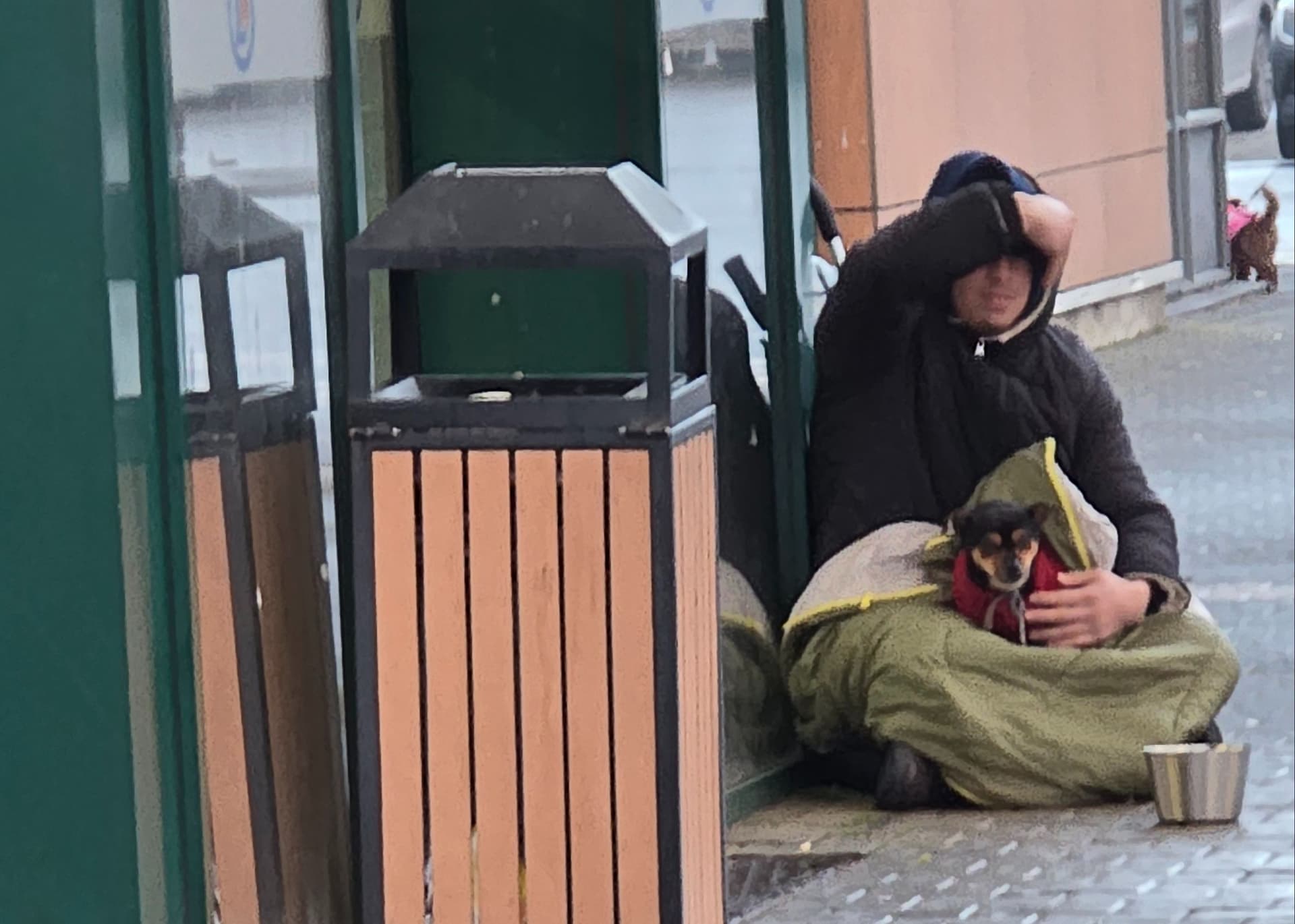
- Those dogs are usually extremely lethargic and show unnatural passivity. They are very likely being sedated with the intention of keeping them still.
- They don’t move nor are they allowed to (they are being dragged back to the blanket if they do..)
- Some get wrapped up in blankets with the intention of keeping them from freeing themselves (much as you would do when ‘swaddling’ a baby, for lack of better comparison)
- They always wear coats (in winter months) and are lying/wrapped up on/in blankets (this is to generate compassion from the passers-by and to demonstrate false care/love from their ‘so-called’ owners).
- Dogs rotate from Beggar to Beggar. They ‘have’ to do their rounds.
- They are often non-responsive and don’t have food and/or, more importantly, Water, and are sitting in the same spot for hours on end.
- They are intimidated if approached and show signs of being fearful and/or lethargic.
- They may have non-treated health problems (seen in dogs that were taken away and checked) and be malnourished.
Some people assume these animals belong to homeless individuals. How can one distinguish between vulnerable people with pets and possible exploitation cases?
Vulnerable people:
- their dogs roam freely, some off leash but also on leash they are allowed to walk and move freely. They show interest in people. They interact (owners as well as their animal).
- they show attachment to their owner, one can see that they have a bond.
- they are being cared for with food and water.
Exploitation:
- the beggars usually avoid any interaction (also in regards to their dogs) except asking for money
- are oftentimes very willing to sell their dogs if you ask and if they do, they either call someone (from the network) to see about the price or 2 or more Men appear straight away to ‘discuss the price’.
- aggressiveness if handed food (for either dog or them). They will tell you that they want money, not food.
- furthermore, all the above mentioned.

How did the public respond when the petition was launched?
As we massively advertised and raised awareness already a month before the Petition was officially put online, we had managed to gain quite a following and generate public interest. We then managed to raise 1000 signatures in the first 24 hours and reached the needed 5500 signatures in less than 14 days. We engaged people on this issue every day.
Some people raised the concern about local beggars and homeless and if their wellbeing could be affected by this Petition of course. We continuously reassured the public that this is not aimed at locals at all. On the contrary. We have statements of local beggars who testify to the hardship they encounter because of these organised Networks. Begging has become more difficult as people are increasingly fed up and tend to put all beggars into the same category now, which is unfair and harms the local beggar. Some beggars/homeless report of their dogs being solicited by organised beggars for begging rounds. Even cases of attempted theft of their dogs have been stated.
What does Luxembourg law currently say about animal welfare and the responsibilities of animal owners?
Under Luxembourgish law (the law of 2018 on the protection of animals) animals are recognised as sentient beings and their welfare and dignity have to be guaranteed! That is a legal obligation! They must be chipped and registered (with the exception of stray cats belonging to agricultural environments) into a Database (Veterinary obligation) and vaccinated (Vaccination Passport)- (outdoor cats need to be neutered/sterilized). Uncontrolled reproduction for monetary gain is not allowed. To become a breeder, you need to be registered and have the necessary permissions. You cannot abandon an animal, nor can you neglect it. The animal must be kept in adequate conditions. You are not allowed to cause unnecessary suffering to your animal. You must ensure the animal’s health and welfare at all times.
Are there specific regulations concerning animals used in public spaces or during begging?
There is, at the moment, no stand-alone legal ruling for the regulation of begging with animals. That is part of the change our Petition is aiming for. The Criminal Code recognises human trafficking when a person is used for begging to draw sympathy. This is in direct relation to using animals to attract compassion. This fits into the concept of exploitation!
Begging itself falls under municipal police regulations. Begging in groups, for instance, is not allowed. A defined perimeter also exists for begging in the city.
Here an excerpt:
- Article 342 (anyone who begs in a group – unless the people are spouses, a parent and their young children, or a blind or disabled person and their guide – shall be punished with imprisonment of eight days to one month).
- Article 382-1 (the following acts constitute a human trafficking offence: recruiting, transporting, transferring, harbouring or receiving an individual, passing on or transferring control over a person, with the aim of forcing them into begging or exploiting them, or making them available to a beggar so that they can be used to elicit public sympathy).
- Article 563, clause 6 (vagrants and those who have been found to be beggars shall be fined €25 to €250).

Which authorities are responsible for enforcing animal protection laws in Luxembourg?
It’s a combined effort between Police (who plays a supportive role and can be the first responder to immediate danger to the animal), Veterinary Inspection (ALVA), Municipalities and juridical authorities. In addition to that, we have animal welfare organisations who report and assist with seized animals. of course people can (and should) of course also report to those authorities. A private person can contact the police to report abuse and can also contact the Veterinary Inspection who are the ones in charge of investigating and carrying out controls. They are also the authority who will order corrective measures or seize animals if necessary.
In your opinion, where are the main gaps or weaknesses in the current legislation?
We need a more effective enforcement! More regular controls! The law itself needs stronger regulations, immediate sanctions and harsher punishments. A 5-year ban from keeping animals, even in serious cases, is far too lenient! Fines should be issued on the spot, and penalties should be severe enough to deter repeat offenders. Instead of working to prevent animals from the risk of being abused, current laws allow action mainly after suffering occurs!
Police officers, who are often times the first responders when it comes to abusive situations have to be able to confirm abuse, falsified papers and warning signs. Foot patrol officers, to my knowledge, usually don’t carry a Chip-reading device. Not all Police stations have them on site either.
As their intervention oftentimes occurs before the Veterinary Inspection is contacted and can react, it is absolutely crucial for the situation to be assessed properly by the first responders/controllers.
Based on your experience as a former animal welfare inspector at the National Déiereschutzliga Lëtzebuerg, how are suspected cases of animal abuse usually investigated?
Anyone can report a violation of animal protection law to the ALVA. The Animal Welfare Service carries out an on-site inspection after each report, and depending on what is found during that inspection, appropriate measures are taken. These measures can vary depending on the situation: the animal owner may be given a deadline to comply with animal protection law, or the matter may proceed through legal channels, which can, among other things, lead to the seizure of the animal concerned.
What should citizens do if they believe an animal is being mistreated?
They should report it directly to Police and/or directly to the veterinary inspection office ALVA (help@deier.lu)

How does Luxembourg generally deal with stray or abandoned animals?
Stray animals can get checked by either police/veterinarian/shelter to see if they are micro-chipped (which is mandatory since 2008-Règlement Grand-Ducal Article 14). Information of the owner is registered on that Micro-Chip, and the latter can then be contacted and pick up his animal which will usually be held at the animal shelter. If it so happens that the animal is not chipped/registered, it will stay at a shelter until the owner can be identified or will be put up for adoption if the owner can’t be found.
Now that the petition has passed the required threshold, what do you expect from the upcoming debate in the Chamber of Deputies?
We are hoping for a very clear recognition of the problem. Meaning: This is not to be seen just an opinion, but a reality! Organised begging does exist and it must be acknowledged that animals are being used in this context. Animal welfare, abuse and exploitation are real. We want specifics in laws/regulations regarding the use of animals in begging! We need increased controls, with access to Microchip-readers on hand and sanctions which could be enforced on the spot. As animals are (supposed to be) protected by law, their welfare must be treated as a priority, and not merely as a secondary concern. We need concrete measures! And those measures need to then be applied! (We, petitioners, do have concrete implementable solutions which would not penalise local beggars/homeless but would directly aim at organised networks and would slow them down considerably)
What message would you like to share with residents of Luxembourg regarding animal welfare?
What I’d like to share most and foremost is to really think it through before getting yourself a companion, be it a cat, a dog, a hamster, a fish... no matter the size, please be aware that animals need time, care, veterinary care, attention, time and so much more to make their life healthy and happy. Be aware that a companion animal such as a dog (and even a cat if indoor and not in pairs), needs your presence. I’d like to tell them not to think selfishly. If you need companionship but are working a full-time job with no alternative care for your dog, leave it! A dog will wait for you from the moment you walk out that door until you come back! Put their needs ahead of yours and look for another way to fulfil your emptiness. Go to a shelter and walk dogs. They are happy to get the exercise, and you would truly help a cause.
Regarding animal welfare in general – or cases of animal abuse. Keep your eyes open. Report animal abuse straight away. Don’t think that the next person will or can do it. Take action! Don’t look the other way!