
How a developer from Siberia can relocate using the Blue Card
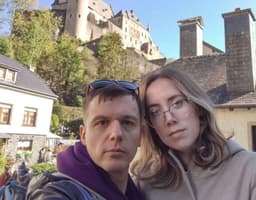
Hello, everyone! We are Artem and Natalia.
If we disregard all the details, we can schematically represent our move as a step-by-step algorithm as follows:
Before moving:
- find a job;
- obtain a contract from the employer;
- prepare and submit visa documents to the consulate;
- rent a temporary flat on AirBnB.
The first 3 days after moving
- obtain confirmation of temporary residence from the local authority.
The first week after moving
- undergo a medical examination (to the extent possible given the queues).
The first month after moving
- rent property for a long term;
- obtain confirmation of your new address from the local authority;
- open a bank account (these steps are done in parallel — account, medical examination, property search);
- prepare and submit documents for a residence permit.
But this does not even begin to convey the full extent of what awaited us on our journey to the Grand Duchy.
"Everyone ends up in Luxembourg by accident."
Artem (hereinafter referred to as A): I have noticed in stories and heard from acquaintances that many people end up in Luxembourg due to a combination of circumstances. I am an exception in this regard; I was immediately interested in the country.
We generally gravitate more towards Europe, and there is a high concentration of interesting things here. We read reviews from expats and ultimately chose this option. We like that there is a high standard of healthcare, education, and life in general here.
Natalia (hereinafter referred to as N): Plus, everything is nearby: France, Belgium, Germany. You can go anywhere.
"I really liked the company, and they hired me."
A: In our case, the decision to move had been brewing for a long time. We didn't like the direction the country was heading in. And after February, there were no doubts left. When the question of moving became serious, I opened LinkedIn and decided to go through the countries on my priority list.
I started in Luxembourg, and it just so happened that there was a vacancy for a software developer there. In total, I had five interviews, after which they offered me a contract. The contract is one of the most important documents. It allows you to obtain a D visa and then a Blue Card.
N: It took about four months. We had to constantly send documents from Tyumen to Luxembourg by email.
"Just send us a copy, we'll accept everything from you."
A: When we signed the contract, an HR manager started working with me and accompanied me through every stage. He also provided a list of all the necessary documents. It took a long time to obtain certificates of no criminal record. And it also took quite a while to get the documents apostilled.
We weren't sure if it was necessary in Luxembourg, but decided to play it safe. It's better to pay a little more once and have all the documents ready to use right away.
The entire list looks like this:
- Notarised copy of your foreign passport.
- A notarised, apostilled copy of my birth certificate (not on the list at guichet.lu, but for some reason my HR department requested it).
- A notarised and apostilled copy of a recent certificate of no criminal record.
And separately, in my case, the following were required:
- A notarised and apostilled copy of your higher education diploma. Education must correspond to the position you are applying for. A specialist diploma is equivalent to a master's degree.
- Notarised and apostilled copy of the marriage certificate.
- A copy of the employment contract.
- Summary.
- A letter of motivation from me.
- Motivational letter from the company (prepared by HR).
- Power of attorney for my HR to send and receive documents on my behalf to the Ministry.
I scanned all the completed documents and sent them to HR. At one point, he said, "Stop! All the documents are ready, send them to us in Luxembourg." And here's the question: the news said that all courier services had stopped working. What should I do?
We immediately gave power of attorney to HR. He submitted all the documents on our behalf to the ministry in Luxembourg itself. The waiting period for consideration is two months. But we were very lucky again. A little less than a month had passed since the application was submitted, and my manager had already received our temporary residence permits. In the end, the Ministry issued two permits: one for me, as the future holder of a Blue Card, and one for my spouse, as a family member.
And here it gets even more interesting. I need to submit the originals of these permits for my visa, and delivery to Russia definitely doesn't work. I call the consulate and explain everything. They say, "Yes, we understand. Just send us a copy and put the fee between the pages. You don't need to come here from Tyumen."
In the end, we sent the following package to Moscow:
- Simple copies of the permits obtained.
- Simple copies of internal Russian passports (main page and pages with registration details).
- Schengen visa application forms (they are the same for C and D visas). They can be downloaded from the website of the Luxembourg Consulate in Moscow.
- Original foreign passports.
- €50 consular fee (the amount may vary at present).
Everything went smoothly, and after a while we received our visas. Overall, the Luxembourg consulate in Russia is very friendly and welcoming.
"Flying out of Russia was more expensive than getting to the heart of Europe."
A: We didn't leave in the usual way. Not via Moscow. First, we took the train to Yekaterinburg. Then we flew to Istanbul, and from there to Luxembourg. We took a connecting flight almost a day later. There had been all sorts of issues with Red Wings, so we decided not to take any chances. But we got to walk around Istanbul and sleep in a proper bed!
N: Yes, it's also worth mentioning that tickets from Yekaterinburg to Istanbul cost us 70,000 roubles for two people. And from Istanbul to Luxembourg — only 30,000. In other words, it was more expensive to fly out of Russia than to get to the heart of Europe.
A: You have to understand that we were essentially transporting ourselves. The company didn't provide any lifts. We are very grateful to them for hiring us in the first place. So yes, everything was our own.
N: We sold the car to cover the cost of the move.
A: We included the cost of rent and up to three months' deposit in this budget. Plus money for food and any unexpected expenses. It came to around 8,000. A friend rented our first flat through Airbnb. The service is no longer available in Russia, but our friend has been living in the Czech Republic for many years and everything works for him.
Essentially, he must give his consent for the local authorities to register you at his place of residence for the initial period. Ideally, the landlord should include your names on the post box, as almost all communication is conducted via post. We were very lucky; the landlord was understanding and very knowledgeable about the procedures, and he helped us a lot. But sometimes landlords refuse to register guests.
"The appointment is at the end of October, and my residence permit is expiring."
A: Generally speaking, legalisation in Luxembourg is not particularly difficult. Everyone here is quite friendly, often understands and speaks English, and some things are very convenient. For example, the social security number issued after registration is your date of birth in year-month-day format plus five digits. This number is the same for all types of services. It is very easy to remember.
In short, we arrived at the council, waited in the electronic queue, everything was done very quickly, we were given our declarations, shown where the numbers were and sent for a medical examination.
The therapists were quick, and the tests were easy — we literally walked in off the street and got everything done. We wanted to pay in cash, but they said, "No need, we'll send you a bill. When you get your card, you can pay then!"
And then there was a turn of events that has left us without documents to this day. Newcomers must undergo a tuberculosis test, similar to the Mantoux test in Russia. To take the test, you need to go to one of three centres. The earliest appointment at that time was on 28 October. So we hope we don't get sick on that day.
But we have been assured that the government is aware of this issue and that everyone is aware of it. It is simply better not to travel abroad for the time being. A political party is planning to engage with residents here. Let us go and express our concerns so that they may put pressure on the government.
The Blue Card is both a residence permit and a work permit. For now, my work permit is replaced by my declaration of registration with the local authority.
In general, to obtain this type of residence permit, my spouse and I need the following documents (for each person):
- A recent copy of your foreign passport (all pages) with visa and arrival stamps.
- A copy of the temporary residence permit.
- Copy of the arrival declaration.
- Housing rental agreement (a housing purchase agreement is also possible, but that is not the case here).
- Receipt for payment of state duty (€80).
Here, they don't really nitpick about documents. When registering, for example, I sent a copy of the form to an employee's email directly from my phone. She received it, printed it out and attached it to the file. And these are important government decisions!
"We have 14 euros left for the week, and the transfer still hasn't arrived."
A: Our biggest problem was getting money. At first, it was even opening an account. Perhaps we hit the dead August season, or perhaps the banks were just very sceptical about our applications.
However, of the three banks we contacted, only one responded relatively quickly — ING. We already had currency purchased on the exchange in Russia, and as soon as the account was opened, we sent it immediately.
As a result, the banks slowed down the transfer. Why are you transferring these amounts? Please confirm the sources... Fortunately, we had brought our 2-NDFL certificates and even the car purchase agreement with us. They were all in Russian, but the bank accepted them and said nothing. We wrote and called, and I wrote to the personal manager. He is a good chap and helped as much as he could.
N: It's come to the point where we've got 14 euros left to spend. What's in the fridge? That chicken isn't quite dead yet, we can have it again.
A: It was only a week, but it felt like an eternity. We even looked into where we could sleep on the streets in Luxembourg. At the same time, we were also looking for a flat. We've already found one that we're going to rent.
The landlords tell us: "Pay for accommodation, pay a bank deposit (frozen amount in the account) and pay insurance. Then we'll give you the keys." But we only have 14 euros, and SWIFT is stuck somewhere...
In the end, a casual acquaintance whom we had never even met in person came to our rescue. She borrowed money from us in euros, and we immediately transferred it to her in roubles. This is a useful tip, by the way, if you interact with the local Russian-speaking community.
As a result, we now live in Bereldange. It can be called a suburb of Luxembourg, not far from Kirchberg. We pay 1,450 for rent and an additional 250 for utilities.
"If you're used to buying eggs and chicken from the lower shelves of the shop, it will be expensive."
A: The products here are very unusual. First of all, there aren't many familiar names, but they are there. I couldn't find the types of vegetable caviar I'm used to: courgette, aubergine, lyutenitsa, etc. But I tried German caviar made from red cabbage. I recently wrote about this in detail.
N: Secondly, meat, dairy products and, for some reason, chicken are very expensive.
A: Yes, I figured out the logic for myself: if you eat like you do in Russia — taking the cheapest products from the bottom shelves — it will be expensive. And it won't be tasty either. But if you try to diversify your diet, for example, with cheese or some other products, smoked meats, it will not be so expensive in percentage terms.
You just need to understand that prices in Luxembourg are generally the highest among neighbouring countries. Some people even organise full-fledged shopping trips to neighbouring countries. For example, a friend of mine bought a second refrigerator so that he could stock up once every 1-2 weeks. He says that in a couple of months, he will recoup the cost of the refrigerator with food alone!
Learn French!
A: What we would recommend to visitors is to learn the language. Preferably French. There are more workers, documents are more often in French, and on average we hear it more often on the street.
N: German is also spoken, but, as far as we could tell, closer to the north of the country. And don't shut yourself off. Try to integrate into society. You can start with the Russian-speaking diaspora. But don't limit yourself to that. We have seen from our own experience how much ordinary people can help.