
Aluminum Sliding Systems in Premium Architecture – Design and Energy Efficiency
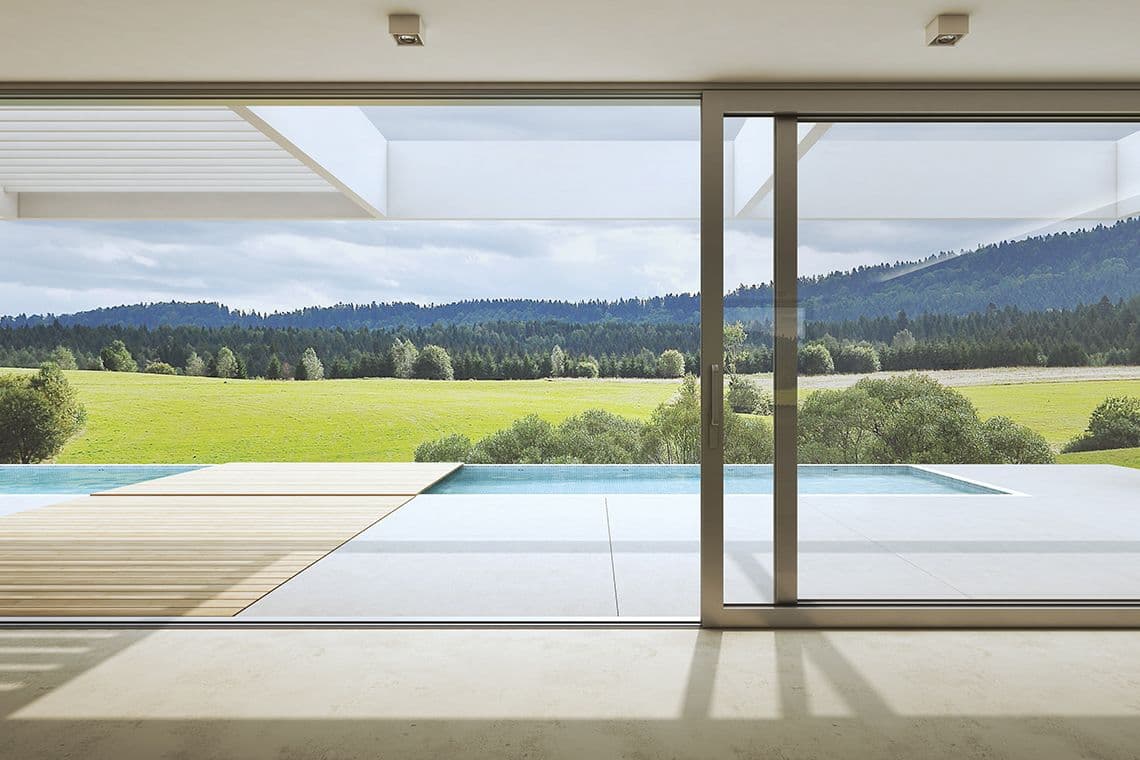
An architect working on a new villa build eventually faces a question that sounds technical but is actually a design issue: how do you open a wall without interrupting it? Large-format aluminum sliding systems are the answer that has become established in premium architecture over recent years – not because of a trend, but because they solve a real problem.
Schüco AS PD 75.HI – When Threshold-Free Design Meets Passive House Standard
What was long considered a contradiction – maximum transparency on the one hand, low heat loss on the other – is now technically solvable. Modern aluminum windows and sliding systems achieve insulation values that would have been unthinkable just a decade ago – and this with panels that are several meters wide and up to three meters high. The material aluminum plays a central role here: lightweight, dimensionally stable, corrosion-resistant, and available in almost any powder-coated color.
The Schüco AS PD 75.HI is one of the systems that consistently implements this standard. The abbreviation HI stands for High Insulation – and that is not a marketing formula. With a Uw value of up to 0.84 W/(m²K), the system far exceeds what conventional sliding solutions offer. At the same time, it enables a completely threshold-free transition between interior and exterior – the flooring runs through, without a step, without a visible transition.
This may sound self-evident, but it is not. Threshold-free design and high thermal insulation are in constructive tension with each other: a low or missing bottom track allows cold to penetrate more easily. Schüco solves this with a thermally broken running track that is recessed deep into the screed, and with continuous triple seals that reliably seal the panel even without a raised threshold. For barrier-free floor plans – increasingly required not only in public construction but also in the private luxury segment – this is a decisive advantage.
Large Format Without Compromises in Energy Balance
What planners particularly appreciate about aluminum windows of this class is the dimensional freedom. While PVC profiles reach structural limits beyond a certain panel size, aluminum remains dimensionally stable even with elements over six meters wide. This enables floor plans that were simply not feasible in the past: floor-to-ceiling glazing that extends across the entire width of the facade, or corner solutions where two panels meet at a column-free 90-degree angle.
The energy side is not left to chance. Triple glazing with Ug values of 0.5 to 0.7 W/(m²K) is standard in these systems, warm edge spacers reduce heat loss at the critical glass edge, and the thermally broken aluminum profiles prevent thermal bridges in the frame itself. Anyone planning a building to KfW Efficiency House 40 standard or in accordance with the GEG can hardly avoid such solutions.
Why Architects Are Increasingly Choosing Aluminum
In addition to the technical properties, it is the design freedom that makes aluminum windows so attractive in the premium segment. Narrow face widths of up to 35 mm maximize the glass area – the result is facades that get by with almost no visible frame construction. Surfaces can be coated in RAL or DB color tones, anodized, or finished in a wood decor. Even demanding color concepts, where interior and exterior sides are to be designed differently, can be implemented without any issues.
In short: anyone planning a high-quality building today, in which interior and exterior spaces are to flow seamlessly into one another, needs solutions that force no compromise on any level. Systems such as the Schüco AS PD 75.HI show that aluminum windows can meet this standard – aesthetically, structurally, and energetically. The result is buildings that not only look good, but will still meet the requirements of modern energy standards in twenty years' time.